CARFMS27: Call for Papers
(le francais suit)
CARFMS27: Call for Papers
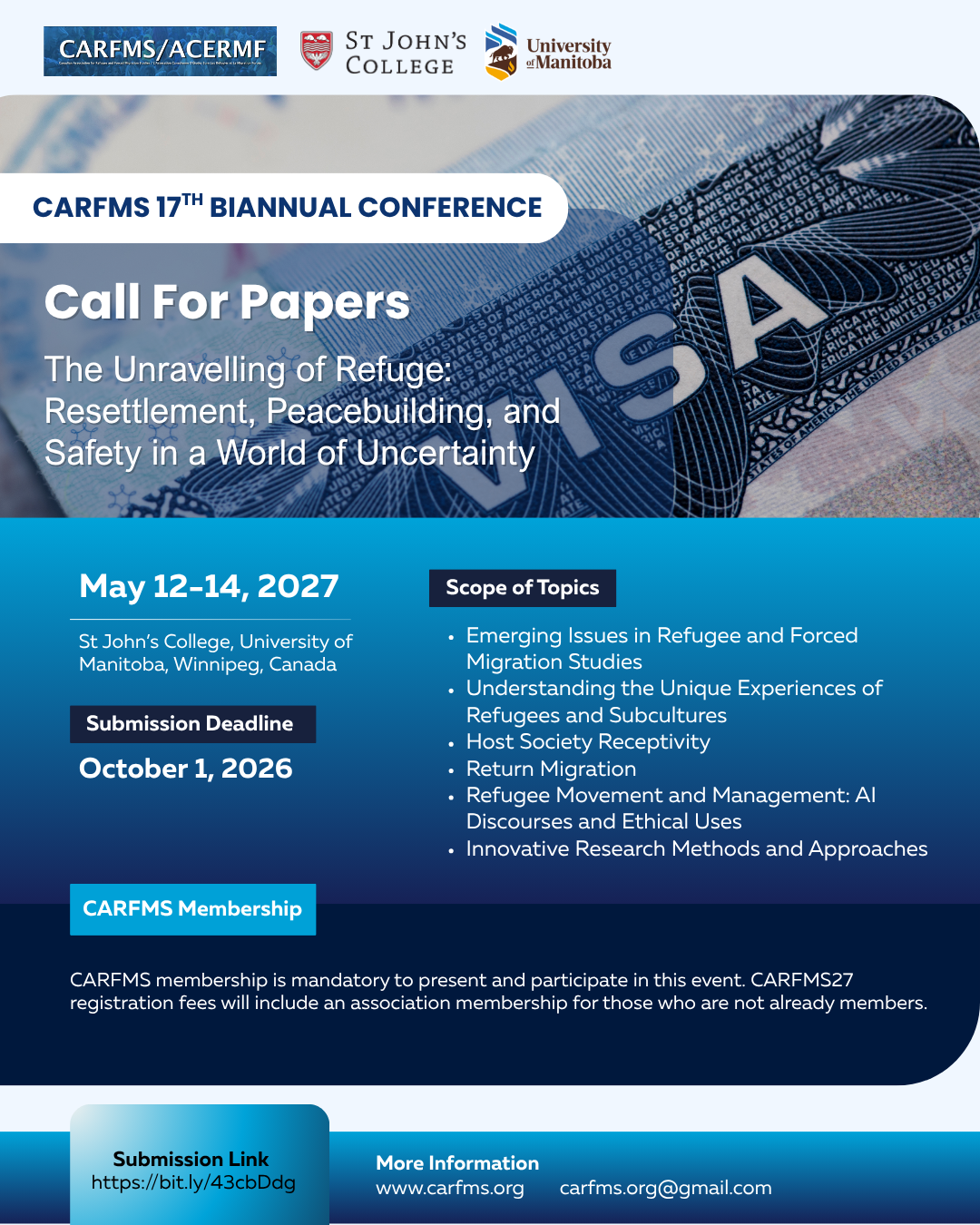
The Unravelling of Refuge: Resettlement, Peacebuilding, and Safety in a World of Uncertainty
17th Biannual Conference of the Canadian Association for Refugee
and Forced Migration Studies (CARFMS)
12-14 May 2027
Hosted in collaboration with
St John’s College, University of Manitoba
Direct link: https://site.pheedloop.com/portal/event/EVEKNUIGFYIDD/submission/CALPJNER4Y8PWSQ/application#start
Submission deadline: October 1, 2026
Today’s global forced migration is defined by deep uncertainty, in ways that were unimaginable in previous decades. Refugees and forced migrants are increasingly rejected at international borders and are detained and deported in larger numbers. Resettlement countries such as Canada and the USA have drastically decreased their commitments to resettlement. Other countries have passed legislation that curtails the resettlement of forced migrants from all regions, while others prioritize those from certain countries. The Consultation on Resettlement and Complementary Pathways (CRCP) in Geneva in summer 2026 will be one of the smallest in recent memory, signalling a near worldwide rejection of refugees and forced migration. The 2027 CARFMS conference is focused on the future of peacebuilding and safety for refugees asking, “What is the future of resettlement as one of UNHCR’s durable solutions?”
While we have listed several themes and subthemes below, we welcome any contribution related to the study of refugees and forced migrants at any stage of displacement and in the resettlement cycle.
We welcome proposals for:
- Research presentations
- Panels, roundtables, or workshops (90 minutes) – please identify the theme and individual contributors and contributions in your submission
- Film screenings, art exhibits, or other multimedia presentations
- Research posters
CONFERENCE THEMES AND SUBTHEMES
1. Emerging Issues in Refugee and Forced Migration Studies
Emerging issues in refugee and forced migration studies are shifting focus toward climate-induced displacement, use of biometric tracking at borders, criminalization of migration, and protracted displacements. Under this theme, we encourage papers examining “forgotten” conflicts, and large-scale conflicts that disproportionately affect many parts of the world. Questions in this section include:
- What innovative solutions to displacement and resettlement have countries proposed?
- What role does political ideology play in determining and identifying refugees?
- How have governments responded to the worldwide crises involving climate change and displacement?
- How do governments’ use of control measures and anti-migrant rhetoric impact the safety, rights, and integration of migrants?
- Why do some conflicts in the world receive more attention than others?
2. Understanding the Unique Experiences of Refugees and Subcultures
While there is an understanding that the experience of forced migration differs significantly based on demographics, country of origin, and arrival country, much research on refugees continues to homogenize this very diverse group. Papers in this section address some of the resettlement challenges of various groups including:
- Women
- 2SLGBTQ+ communities
- Age of refugees
- Refugees and forced migrants with disabilities
- Refugees from the Global South
3. Host Society Receptivity
The global approach to refugee displacement is increasingly volatile, driven by unpredictable political agendas. Political dynamics critically shape how refugee and forced migration is experienced, managed, and resolved. Papers in this section address the following issues:
- Political extremism (e.g., right-wing and left-wing anti-refugee ideologies)
- Economic outcomes and scapegoating refugees
- Host society receptivity toward refugees
4. Return Migration
Increasingly, refugees are returning to their countries of origin. Some return in the aftermath of the conflict to help rebuild. Many more, however, return because they are unable to successfully integrate in their new homeland or are forced out of their temporary homes because the host country no longer wishes to provide them safe shelter. Papers in this section focus on:
- Why are countries forcibly returning migrants?
- What are the experiences of return migrants?
- What resources and services are available for return migrants?
- Do return migrants have successful re-integration?
5. Refugee Movement and Management: AI Discourses and Ethical Uses
Countries are applying AI “technologies” to “manage” the arrivals, resettlement and detention of would-be migrants. Countries like Canada are “triaging” queues of hundreds of thousands of refugee applicants as a way of speeding up the processing of applicants. We welcome papers in this section which examine the following:
- Uses and misuses of AI for migrant processing by governments
- Unintended consequences of using AI for making refugee determination
- The use of apps and other geo-mapping technologies during the migration process by migrants themselves
- New technologies that assist refugees in resettlement and settlement
6. Innovative Research Methods and Approaches
CARFMS conferences provide a forum for presenting the latest research methods and approaches in the field of refugee and forced migration studies. Increasingly, researchers are partnering with refugees or others with lived experience of displacement to co-produce research. We welcome submissions related to:
- Benefits and challenges of co-produced research with forced migrants
- New, innovative, or creative methodologies
- Ethics of forced migration research
- Recruitment of hard to locate participants
The conference will be held, in person, at St John’s College, located on the ancestral lands of the Anishinaabeg, Ininiwak, Anisininewuk, Dakota Oyate and Denesuline, and on the National Homeland of the Red River Métis at the University of Manitoba, in Winnipeg. Limited travel subsidies may be available. For participants from countries requiring visas to enter Canada, we will issue visa invitation letters upon request. Please note that the processing times for such visas can be quite lengthy, so it might not be possible to receive a visa in time for the conference (visit IRCC’s website to check processing times). In other words, apply early!
CARFMS27 REGISTRATION & MEMBERSHIP
CARFMS membership is mandatory to present and participate in this event. CARFMS27 registration fees will include an association membership for those who are not already members. Those who purchased a CARFMS membership between conferences and whose existing CARFMS membership is still valid after 14 May 2027, your CARFMS27 registration rate will be discounted accordingly. There will be different registration fees for students, faculty members, etc. More information on registration and conference fees will be available in the fall.
CARFMS membership fees and donations are the main source of the Association’s operating and program costs. A membership in CARFMS enables access to events and activities that will help you network with scholars and practitioners, as well as keep current with research topics, approaches, and methodologies in the field of refugee and forced migration studies. CARFMS hosts a conference every two years, an annual student essay contest, a blog, a working paper series, and regular webinars. For more information, please see https://carfms.org/.
************************************
CARFMS-ACERMF27 : Appel à communications
Effilocher le refuge : réinstallation, consolidation de la paix et sécurité dans un monde d’incertitudes.
17e Conférence biannuelle de l’Association canadienne d’études sur les réfugiés et la migration forcée (ACERMF)
12-14 mai 2027
Organisée en collaboration avec le Collège St. John’s de l’Université du Manitoba
Soumettez votre proposition en ligne
Lien direct : (https://site.pheedloop.com/portal/event/EVEVVAQDHFANF/submission/CALNOPZE3Q1D6KB/application#start)
Date limite de soumission : 1er octobre 2026
A l’échelle mondiale, la migration forcée est actuellement marquée par un niveau d’ incertitude qui aurait été difficile à imaginer au cours des décennies précédentes. Les personnes réfugiées et en situation de migration forcée sont de plus en plus souvent refoulées aux frontières internationales et sont détenues et expulsées en plus grand nombre. Les pays de réinstallation, comme le Canada et les États-Unis, ont considérablement réduit leurs programmes de réinstallation. D’autres pays ont adopté des lois limitant la réinstallation des personnes migrantes forcées de toutes les régions, tandis que d’autres privilégient les migrantes et migrants forcés originaires de certains pays. La Consultation sur la réinstallation et les voies complémentaires (CRCP) qui s’est tenue à Genève à l’été 2026 a été l’une des plus restreintes dans l’histoire récente, témoignant d’un rejet quasi global des personnes réfugiées et en situation de migration forcée. La conférence de l’ACERMF de 2027 est axée sur l’avenir de la consolidation de la paix et de la sécurité des personnes réfugiées et pose la question suivante : « Quel est l’avenir de la réinstallation en tant que l’une des solutions durables du HCR ? »
Bien que nous ayons énuméré ci-dessous plusieurs thèmes et sous-thèmes, nous saluons toute contribution relative à l’étude des personnes réfugiées et en situation de migration forcée à tous les stades du déplacement et du cycle de réinstallation.
Nous acceptons les propositions suivantes :
- Présentations de recherche
- Panels, tables rondes ou ateliers (90 minutes) – veuillez préciser le thème, les intervenants et leurs contributions dans votre proposition
- Projections de films, expositions artistiques ou autres présentations multimédias
- Posters de recherche
THÈMES ET SOUS-THÈMES DE LA CONFÉRENCE
- Enjeux émergents dans les études sur les réfugiés et la migrations forcée
Les enjeux émergents dans les études sur les réfugiés et la migrations forcée mettent l’accent sur les déplacements induits par le climat, l’utilisation de données biométriques
aux frontières, la criminalisation des migrations et les déplacements prolongés. Ce thème encourage les communications analysant les conflits « oubliés » et les conflits de grande ampleur qui affectent de manière disproportionnée certaines régions du monde. Ce thème aborde les questions suivantes :
- Quelles solutions innovantes les pays ont-ils proposées en matière de déplacements et de réinstallation ?
- Quel rôle joue l’idéologie politique dans la définition et l’identification des personnes réfugiées ?
- Comment les gouvernements ont-ils réagi aux crises mondiales liées aux changements climatiques et aux déplacements de population ?
- Quel est l’impact des mesures de contrôle et des discours anti-migrants déployés par les gouvernements sur la sécurité, les droits et l’intégration des personnes migrantes ?
- Pourquoi certains conflits dans le monde reçoivent-ils plus d’attention que d’autres ?
- Comprendre les expériences uniques des personnes et des groupes réfugiés
Bien qu’il soit admis que l’expérience de la migration forcée varie considérablement selon les caractéristiques démographiques, le pays d’origine et le pays d’arrivée, de nombreuses recherches sur les personnes réfugiées continuent d’homogénéiser ce groupe pourtant très diversifié. Les articles de cette section abordent certains des défis de réinstallation rencontrés par différents groupes, notamment :
- Les femmes
- Les communautés 2SLGBTQ+
- L’âge des personnes réfugiées
- Les personnes réfugiées et les migrantes et migrants forcés handicapés
- Les personnes réfugiées originaires des pays du Sud
- Réceptivité des sociétés d’accueil
L’approche mondiale du déplacement des personnes réfugiées est de plus en plus instable, sous l’influence d’agendas politiques imprévisibles. La dynamique politique façonne de manière cruciale la manière dont la migration forcée est vécue, gérée et résolue. Ce thème porte sur les aspects suivants :
- L’extrémisme politique (par exemple, les idéologies anti-réfugiés de droite et de gauche)
- Les conséquences économiques et la stigmatisation des personnes réfugiées
- La réceptivité des sociétés d’accueil envers les personnes réfugiées
- Migration de retour
De plus en plus de personnes réfugiées retournent dans leur pays d’origine. Certains rentrent après un conflit pour participer à la reconstruction. Cependant, beaucoup d’autres rentrent car ils et elles ne parviennent pas à s’intégrer avec succès dans leur nouveau pays d’accueil ou sont contraints de quitter leur logement temporaire, le pays d’accueil ne souhaitant plus leur offrir un abri sûr. Ce thème porte sur les question suivantes :
- Pourquoi les pays refoulent-ils les personnes réfugiées et migrantes ?
- Quelles sont les expériences des migrantes et migrants de retour ?
- Quelles ressources et quels services sont disponibles pour les migrantes et migrants de retour ?
- Les migrantes et migrants de retour réussissent-ils leur réintégration ?
- Mouvements et gestion des personnes réfugiées : discours sur l’IA et usages éthiques
Les pays utilisent des « technologies » de l’IA pour « gérer » les arrivées, la réinstallation et la détention des demandeurs d’asile. Des pays comme le Canada « trient » des centaines de milliers de demandes d’asile afin d’accélérer leur traitement. Nous encourageons les contributions à cette section qui examinent les points suivants :
- Usages et abus de l’IA dans le traitement des personnes migrantes par les gouvernements
- Conséquences imprévues de l’utilisation de l’IA pour la détermination du statut de réfugié
- Utilisation d’applications et autres technologies de géolocalisation par les personnes migrantes elles-mêmes durant leur parcours migratoire
- Nouvelles technologies d’aide à la réinstallation et à l’intégration des personnes réfugiées
- Méthodes et approches de recherche innovantes
Les conférences de l’ACERMF offrent une tribune pour la présentation des méthodes et approches de recherche les plus récentes dans le domaine des études sur les personnes réfugiées et la migration forcée. De plus en plus, les chercheurs collaborent avec des personnes réfugiées ou d’autres personnes ayant une expérience vécue du déplacement afin de coproduire des recherches. Nous acceptons les propositions portant sur :
- Les avantages et les défis de la recherche coproduite avec des personnes déplacées de force
- Les méthodologies nouvelles, innovantes ou créatives
- L’éthique de la recherche sur la migrations forcée
- Le recrutement de participants difficiles à trouver
La conférence se tiendra en présentiel au Collège St. John’s, situé sur les terres ancestrales des Anishinaabeg, Ininiwak, Anisininewuk, Dakota Oyate et Denesuline, et sur le territoire national des Métis de la rivière Rouge, à l’Université du Manitoba, à Winnipeg. Des aides financières limitées pour les déplacements pourraient être disponibles. Pour les personnes participantes originaires de pays exigeant un visa pour entrer au Canada, nous délivrerons une lettre d’invitation sur demande. Veuillez noter que les délais de traitement de ces visas peuvent être longs ; il est donc possible que vous ne puissiez pas obtenir votre visa à temps pour la conférence (consultez le site Web d’IRCC pour vérifier les délais de traitement). En d’autres termes, faites votre demande au plus tôt !
INSCRIPTION À CARFM-ACERMFS27 ET ADHÉSION À L’ACERMF
L’adhésion à l’ACERMF est obligatoire pour présenter une communication et participer à cet événement. Les frais d’inscription à CARFMS-ACERMF27 incluent l’adhésion à l’association pour les personnes qui n’en sont pas encore membres. Les personnes ayant souscrit une adhésion à l’ACERMF entre deux conférences et dont l’adhésion est toujours valide après le 14 mai 2027 bénéficieront d’une réduction du tarif d’inscription à CARFMS-ACERMF27. Des tarifs d’inscription différents seront appliqués aux étudiants, aux professeurs, etc. Plus d’informations sur les frais d’inscription et de conférence seront disponibles à l’automne.
Les cotisations et les dons des membres de l’ACERMF constituent la principale source de financement des coûts de fonctionnement et des programmes de l’association. L’adhésion à l’ACERMF donne accès à des événements et des activités qui vous permettront de développer votre réseau professionnel et de rester informé(e) sur les sujets, approches et méthodologies de recherche dans le domaine des études sur les personnes réfugiées et la migration forcée. L’ACERMF organise une conférence tous les deux ans, un concours annuel de dissertations pour les étudiants, un blog, une série de documents de travail et des webinaires réguliers. Pour plus d’informations, veuillez consulter le site https://carfms.org/.